Showing posts with label epistolary books. Show all posts

Thursday, August 31, 2017

Lady Susan/ Jane Austen / 84 pgs

Lady Susan is a short story by Jane Austen that I had never read because I'd heard it wasn't really complete. I decided to take the plunge because the book has been turned into a movie titled Love and Friendship and I would like to see it.

The story is told through a series of letters amongst a small set of people. The main character, Lady Susan, is a woman in her mid-thirties who emotionally manipulates people, generally men but ladies as needed. She's a recent widow with a 16-year-old daughter, a timid girl whom she would like to marry off to a man that the girl abhors. Lady Susan is also in the midst of an affair with a married man but that doesn't stop her from flirting and manipulating a man twelve years her junior.

This novella is full of Austen's commentary on personality and society but in the end it falls flat because there is nothing redeemable or likable about Lady Susan. Austen probably knew this because she ends the story with a short summation and never attempted to publish it. I'm sure the movie will be much more fleshed out and I look forward to seeing where they take the story and the character of Lady Susan.

Sunday, July 30, 2017

Love and Friendship/ Jane Austen / 52 pgs

This is one of Austen's earlier works, written when she was very young. It's a short series of letters  written by "Laura," detailing her chaotic life. I can best sum up Laura by this word: dingbat. Her letters are funny in the way that Austen portrays her shallowness and complete lack of sense. The tale is entirely unbelievable with its frequent coincidences and outlandish behavior from Laura. However, you can see glimpses of Austen's cutting wit and her keen sense of observation.

Tuesday, March 21, 2017

Where'd You Go, Bernadette / Maria Semple / 330 pgs

This is the second time I've read this book. My book club will be talking about it in June, but I went ahead and reread it now, although that's not quite the right way of putting it. I actually listened to it. I'm just going to say this is one of those books where reading it is FAR better than listening to it. I wasn't a fan of the narrator, and the letters, e-mails, and faxes lose their charm when you're hearing them, rather than reading them.

This is mostly an epistolary novel, though it is also narrated in sections by Bee Branch, a 15 year old girl, who sounds like a whiny brat in the audio book, but did not come across so in the print book. Her agoraphobic mother, Bernadette Fox, has gone missing, and it is through all of these letters, e-mails, and faxes that Bee is trying to piece together how, why, and where her mother disappeared.

The story is fun, funny, and kind of crazy. I enjoyed it back in 2014 when I first read it, and I still enjoyed it this past week, even if the audio book was not the best way to experience the book. The movie has been in development for quite a long time, with Cate Blanchett attached to star as Bernadette. Would recommend!

Monday, January 23, 2017

The Guernsey Literary and Potato Peel Pie Society / Mary Ann Shaffer and Annie Barrows / 274 pgs

This was entirely one of the sweetest, nicest books I have ever read. The story concerns Juliet, a woman in her early 30's who lived in London during WWII and wrote a newspaper column about a fictional woman living in London during the Blitz. The columns are turned into a book and she goes on a trip around the country in promotion of her book. However, Juliet is just a little tired and ragged after a long war, so when she receives a letter from a man on the island of Guernsey on the subject of one of their shared favorite authors, a whole new adventure for Juliet begins. The stories of the people living on Guernsey fascinate Juliet. Guernsey is an island in the English Channel that really was occupied by German forces for five years during WWII. In the book, one way the islanders dealt with the challenges of being occupied was to form the Guernsey Literary and Potato Peel Pie Society. So, though the circumstances of German occupation really did happen, the characters in this book and the Society they formed are fictional. To tell you how such a society formed and how it got its name would be spoilers. You will have to read for yourself!

The entire book is comprised of letters between Juliet, her publisher, her friend in Scotland, and her new friends on Guernsey. I highly recommend the book if you want a fun read. To say its completely light would be wrong, because of the ravages of war are described within, but it is a heartwarming story and it has a happy ending.

This book fulfilled one of the categories in the ReadHarder challenge: Category #14: Read a book about war
It also fulfills one of the categories in the PopSugar Reading challenge: Category #3: Read a book of letters

Thursday, April 21, 2016

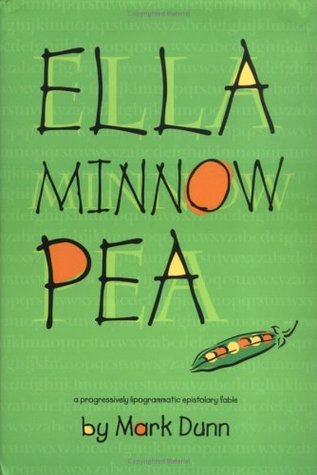
Ella Minnow Pea / Mark Dunn / 208 pgs

This little book was a quick read, but very cute. It is a satire all about censorship and totalitarianism. The residents of the little island of Nollop off the coast of South Carolina find themselves having to speak and write without the use of certain letters when the town's monument to the sentence "The Quick Brown Fox Jumped Over the Lazy Dog" starts to disintegrate, and the governing High Council decides that it is a supreme being who wishes  the island's population to stretch their vocabulary by no longer using those particular letters of the alphabet.

The entire book is epistolary with letters written between the titular character and her cousin, her mother, her father, her cousin's mother, and a few other characters. At first, the epistles' vocabulary grow as the characters are forced to find more quaint and archaic words to get around the growing number of illegal letters of the alphabet, but as more and more letters drop from the monument, the epistles go in the opposite direction. They start to sound as if a small child had written them.

***FAIR WARNING*** You will find yourself having to sound out the gibberish in the letters towards the end of the book just to make sense of what is written.